

The Making of Window Seat: The First Fully AI-Generated Feature Film In History
How the first fully AI-generated feature film was made. Written for the third anniversary, July 21, 2026.
By Hooroo Jackson
I. The Camera on Fire
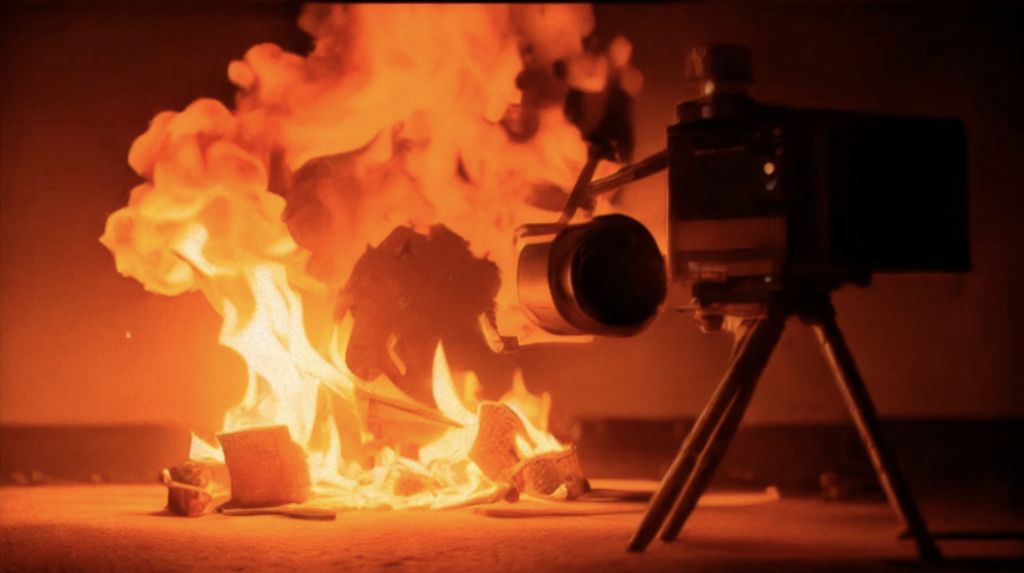
Window Seat opens with a movie camera on fire.
It burns in claymation, the soft, molten, hand-worked texture that the earliest video models produced by accident and that no tool has produced since. When the shot came out of the machine generated video algorithm, I recognized the symbol at once. I knew with all my heart and full fury that the movie would open with this shot. There was no deliberation, no alternates list, no second thoughts. The first AI feature film would begin with the instrument of the old cinema on fire.
The film breaks the third wall there, before it has even introduced a character. Film sets burn across the running time. A parade of disgraced directors and producers passes across the frame. This is not how films usually announce themselves. When a new medium arrives, its early works tend to be sweetness and demonstration, I call the Hello World moment; and to the dismay of those wishing the same for AI, such as Disney’s hopeful experiments, or proofs of concept that ask politely for a seat at the table, Window Seat came as hard, vulgar, indie theater. This was ultimately, not such a stretch; indies in the 90s tradition were openly raw and, to this day, are embraced across every major cinema, technology and critical institution without controversy. But somehow, for whatever reason, I came across an expectation of decorum, a lack of expression, in AI cinema in its earliest days. While I decided to open it by burning down the room it was walking into.
Window Seat is the first fully AI-generated feature film–every frame, every performance. It is a feature film with a running time of one hour, one minute, and fifty-five seconds. It was released to the public on July 21, 2023. It was assembled from roughly 4,000 machine-generated video clips of about five seconds each, laid over a fully machine-performed dialogue track. It was written, directed, cast, performed, generated, and edited by one person. Its total production cost was $100.
Every one of those numbers has been contested, doubted, or targeted in the three years since. That is why I wrote this essay. A first is a fragile thing. It happens once, is usually witnessed by almost no one, and then it spends the rest of history depending on the quality of its paperwork.
This is the story of how Window Seat was made, the eight years of troubles that preceded it, the email that started it, the $95 that financed it, the 4,000 clips that composed it, and the two July dates that ended it.
II. Eight Years
To understand Window Seat, you have to understand that it is my second film. Second films have a particular energy. A debut is made from the fires of a lifetime of ideas; while a second film is made with composure. Certainly there were many potential second films on my slate that were more polished, more behaved, and market oriented. Window Seat would not be such a film. It would burn the screen, no different than my debut, for similar reasons, and for entirely new ones.
My debut, Aimy in a Cage, came out in 2015. It was a traditional production in every sense, and an accomplished one with a fully Hollywood cast including Crispin Glover and the Oscar-nominated Terry Moore. There was a real crew of over thirty, real sets, a budget of half a million dollars. I financed it by going to the ends of the earth: I had been an early holder of Bitcoin, and I sold it to raise the budget. Let that stand as its own monument to conviction. I traded what would have become, as of this writing, a $90 million fortune, for a first feature, and I have more than once run the math on what that Bitcoin would be worth had I never made the film.
Aimy in a Cage won major prizes on the festival circuit. It secured distribution. It became and remains a beloved cult classic, albeit an incredibly controversial one. The film had the stuff. It was on screen. Anyone could look.
And it led to eight years of dead ends. Every meeting went nowhere. Every greenlight was a false start. Every attachment faltered. Every producer collaboration ended in disaster, often ending over a single disagreement. Through all of it I operated as a working director, writing, packaging, and casting numerous scripts, doing the job in every respect except the one that mattered, which is shooting. There were two near misses in those years, projects that got close enough to taste, casted, with financing in place, and both fell apart. The track record was dismal. My dream experience with Aimy was quickly turning into a living nightmare, and the lesson it taught me was not personal: the state of the film business was untenable for independent filmmakers. Merit had almost nothing to do with outcomes. One connection meant the difference between a career and the void. The world gave me nothing for the film, and it started to seem like my dream simply wouldn’t happen.
It was in late 2022 that I wrote Window Seat. It was written for live action, before AI filmmaking was even a thought, and it was the script I worked hardest on. Ten drafts, twenty drafts, thirty drafts. A part of me knew, as I did revision after revision, that this would be my next film. I just didn’t know it would actually be the case. I had no financing, no path, no reason to believe. I was relying, perhaps, on another crypto windfall and to finance it in microbudget. But I knew. I even had actors planned out for the parts. I imagined the bully character, Raiden, as a working-class New York figure, a Gen-X punk.
The model for the script was Polanski via Knife in the Water, his 1962 debut: three people were confined to one vessel, and the pressure of proximity doing all the work that money usually does. I wanted to make my own. Window Seat is that at 10,000 feet: a tech CEO named Thom Claw, trapped on a flight while damaging chat logs surface and his life detonates in real time, discovering that the passenger across the aisle is Raiden, his high school bully, while his girlfriend Millie twists the knife from the adjacent seat. There were other influences, like Albee and Mamet with a fuselage around them; this was a taut, claustrophobic thriller in the style of hard theater. It ached.
The beauty of it had all these mechanics happening off the screen from characters you don’t know about, but that are imminently threatening our main cast. This to me reaches the height of a kind of cinema with scale, in the Shakesperean sense of advancing armies off the stage, this is the tradition of cinema without much means. I just didn’t realize how little means.
There was a fever in the writing that came from somewhere very specific. The script was my reaction to cancel culture, which made it grimly ironic that my later AI productions would inspire actual attempts at reputation destruction. I conceived of AI cinema from the beginning as an instrument of unprecedented creative freedom: a way around the committees, intermediaries, and institutional calculations that gradually take decisions out of a director’s hands. Window Seat therefore did not emerge as a polite demonstration of the technology. It carried the confrontational energy I associated with the independent cinema of the 1990s: raw, vulgar, politically impolite, and answerable to one director alone.
At the time, all this translated into this story about a man watching the mechanism assemble itself against him in real time, at altitude, with no exit. I did not know, while writing it, how I would ever make it. But I was dead certain, feverishly passionate, that I would make this movie.
When I showed the script to my frequent collaborator Vincent Kane, he said: “I thought you were a better writer than this.”
Kane thought the script was beneath me. Much later, after seeing the finished film, he reversed himself and said the final film was far better than the screenplay.
III. The Email
I don’t even remember signing up for Runway’s mailing list. Everything, the film, the milestone, the theory books, the entire body of work that followed, descends from a piece of marketing email I have no memory of soliciting. One day in 2023 it was simply there in my mailbox: Runway, an AI company I had no relationship with, introducing something called Gen-2.

For context: Runway’s Gen-2 was announced in March 2023 and became broadly available that summer. It was among the first publicly usable text-to-video systems: you typed a prompt, and the machine returned a few seconds of silent, low-resolution, often hallucinatory video. There was no sound or any particular consistency. Clips measured in single-digit seconds. To almost everyone who touched it, it was a toy that made GIFs of melting dogs.
I had absolutely no plans to enter AI filmmaking. It seemed like something only the most advanced tech geniuses would get into, and my expectation was that I would watch from the sidelines, argue from the sidelines, and experience the revolution as a spectator achieved by the most connected and privileged among us. I did not realize at the time that AI was not for them, it was, specifically, by design, for us. Else, I frequently say, why would it be needed? What I did have at the time, was a head start on the adjacent technology: I had been early to ChatGPT, and would later learn my account stood within the first 0.1 percent of users, a fact preserved in my account data.
ChatGPT had launched on November 30, 2022, the same season I was drafting Window Seat and became the fastest-growing consumer application in history, reaching a million users in five days and an estimated hundred million within two months. So while I did not think of myself as a technologist, I was already living inside the new machines daily when the Gen-2 email landed. The distance between “arguing from the sidelines” and “generating video” turned out to be one click.
I did not begin with a feature. I began with screen tests, a series of AI short films that went up on my channel, little narrative clip films with the Runway watermark still burned into the frame. There were seven of them before the feature: The Horse Killer, House Mom, The Cursed Forest, Castlevania, Pirate CEO, Black Jesus, and The OceanGate Titan Disaster. I had never been so engaged, so immersed. After eight years of scarcity, I was living inside post-scarcity, having the infinite in front of me. There was no meticulous, endless planning, scripting, storyboards. I was generating and having a finished product by the end of the night. I frequently state in my essays, we are arriving at an efficiency of 10,000x to one. That is not the difference between a film and a better film, it is the difference between 0 and 1. No film and filmmaking; from one day to the next, I crossed over onto the other side.
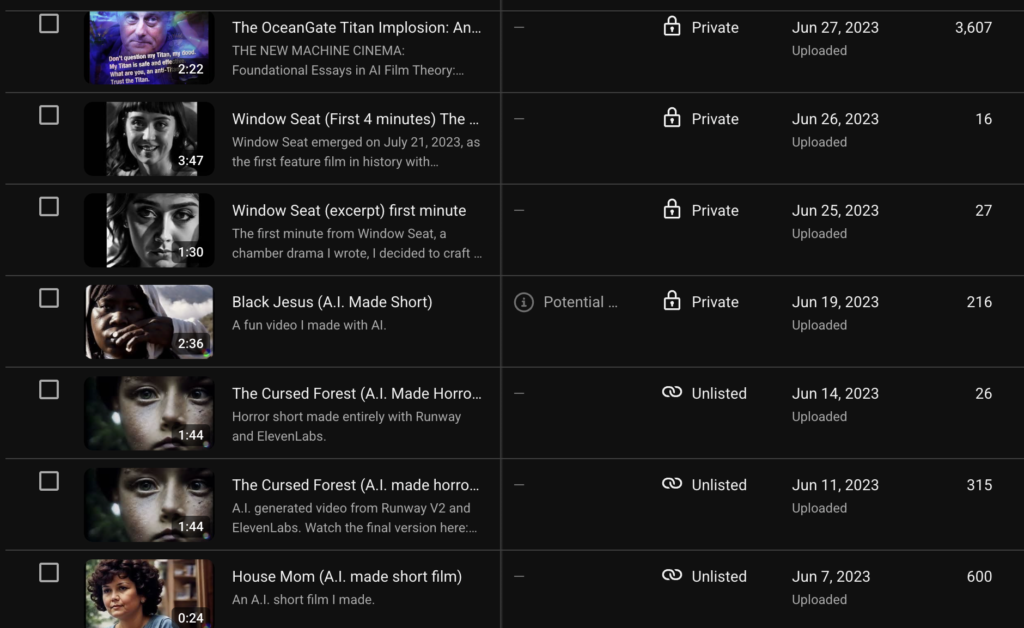
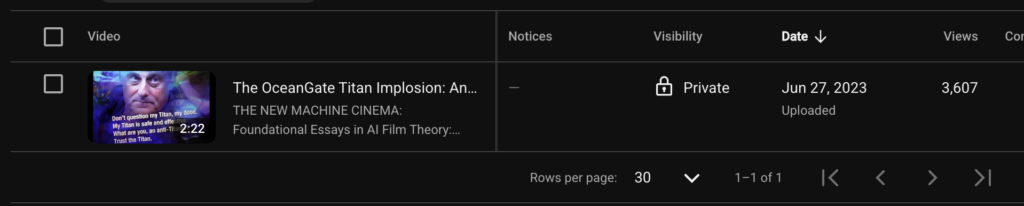
The OceanGate short changed my understanding of what I was holding. The Titan submersible was lost on June 18, 2023, and the wreckage was confirmed on the 22nd; my narrative short about the tragedy was up within a couple of days of the event. It reached 3,500 views. This was, at the time, my most-watched and most-respected upload. But the point was the turnaround. I had produced a narrative film about a world event while the event was still in the headlines, almost immediately. Standing in that moment, I saw the future with total clarity: a world where narrative video responds to the world at the speed of news. Where a Hollywood film opens and an AI counterpart opens the same day and actually bests it, made at the cost of 10,000x less. That vision sounded like delusion in June 2023. Three years later, with public campaigns calling for AI counter-versions of studio tentpoles, we are inching toward it on schedule.
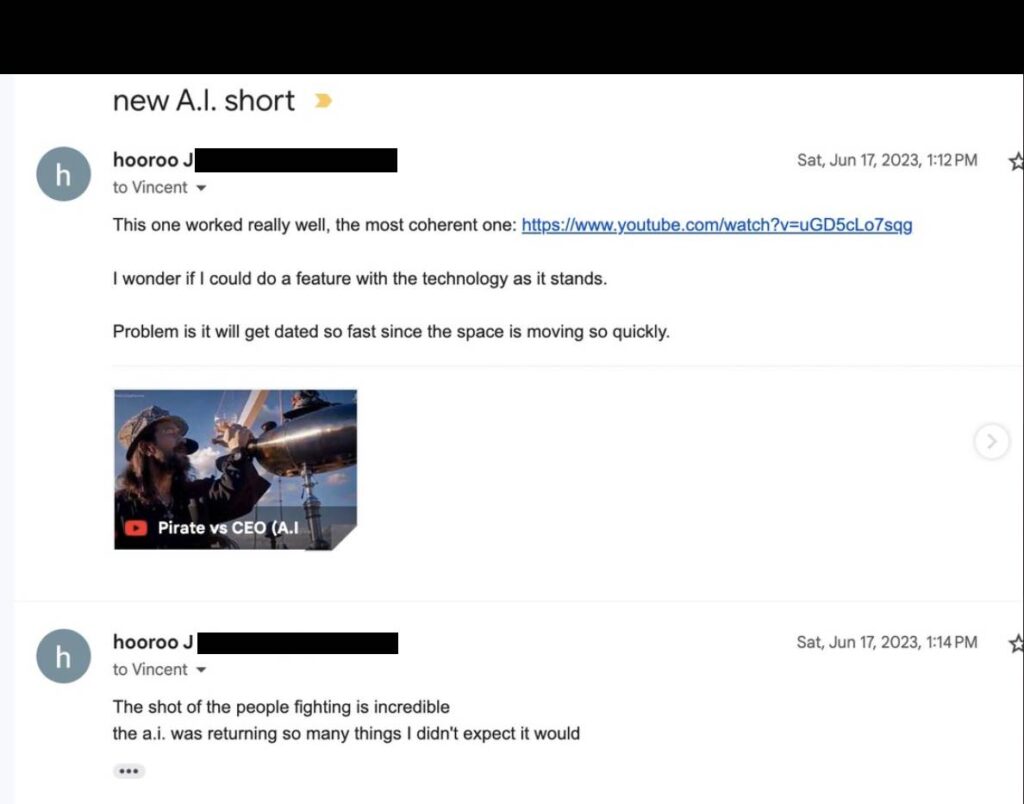
The eighth test was Window Seat itself. I decided to shoot the first couple of minutes of the script: the live-action script. And it came out so well that the floor of my life moved. I realized immediately, physically, that this could be a feature film. That night I emailed Vincent Kane.
The $100 budget came from one month of Runway’s unlimited-generation plan powering the entire film.
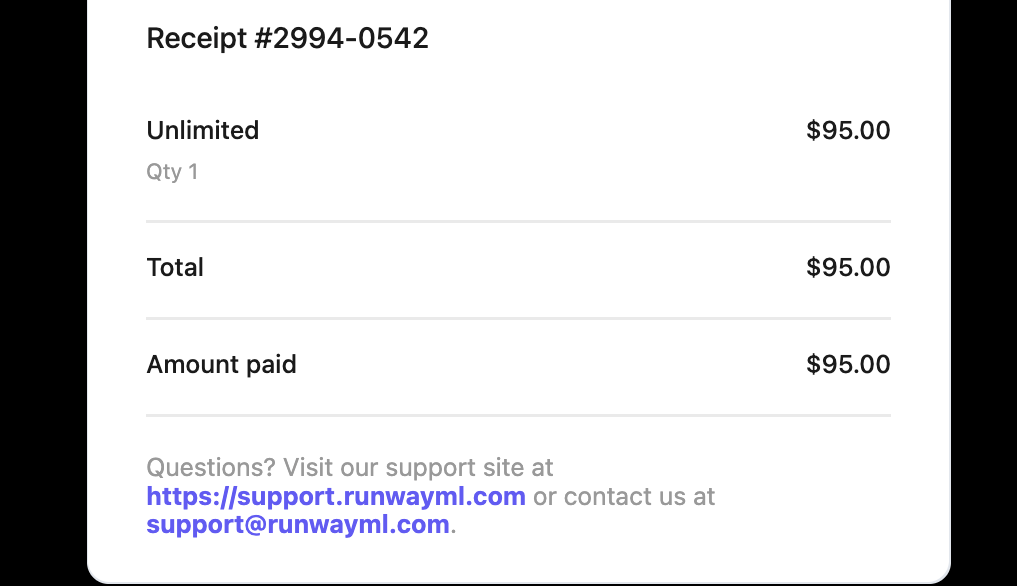
For scale: Robert Rodriguez’s El Mariachi, the patron saint of impossible budgets, cost $7,225 in 1992 and required Rodriguez to check himself into a medical research facility as a paid test subject to raise it. Window Seat was made for $100 in 2023, and unlike its ancestors, it required no crew, no borrowed guns, no film stock, no favors.
In the process of greenlighting the film I had no idea whether it would work. None. And this has been the case for every film I have made since: the not-knowing never goes away, it is a permanent feature of working at the cutting edge of AI cinema tools. This is why I made these films and others didn’t. Every candidate who looked at these tools faced the same uncertainty I did. The difference is I was enamored, I saw opportunity, privilege, honor. Others saw a wall in front of them. Today, many AI directors even put on a persona that they’re ashamed to be working with AI, they nod with the haters and apologize for their work. I have taken the opposite stance, I have been proud, vocal, and stood behind AI cinema completely, from the very beginning.
I had even taken to ChatGPT as a writing partner. The pilot’s running jokes over the intercom were lines directly written by GPT, as were some of Raiden’s creative Irish insults. This was natural at the time, but becomes more interesting upon reflection. As far as I have ever been able to establish, these are the earliest machine-written lines delivered in any feature film, another small first buried inside the large one.
IV. The Performances Doctrine
Every account of the film leads with the video, but actually, the performances were the star of Window Seat. If Runway was the most valuable player in starting the production, ElevenLabs was its foundation.
My original doctrine was this: the film would be built as a radio play first. I would direct the machine performances until the complete dialogue track, laid end to end, stood on its own as an audio drama, until, if you closed your eyes, you were listening to a legitimate chamber thriller. This was something I had been hungry for. In fact, during that eight year dry spell, I directed several audiobook adaptations of my novels. I worked with actors, courted them, and brought the books to market. And almost every single time, it was nothing but trouble tracking them down and getting any cooperation. But that skillset existed, alongside many nights spent hungering for an easier way. The point is I was attacking the cinema dream from every conceivable angle. Ultimately, the fusion of skillsets made all the difference for Window Seat, because other AI filmmakers in mid-2023 were not bringing in a background in direction. My interest was, from the start, not in the visuals but in the performances.
If the performances worked, the film would work, no matter how primitive the picture. It is where all the pleasure in a production lives. This is the single most important creative decision in the history of my workflow. It carried Window Seat, and it has carried every subsequent film.
Understand what directing a performance meant in the ElevenLabs of early-to-mid 2023. This was an early, primitive iteration of the technology, but it was believable. It passed the ear test, which was the miracle the whole doctrine rested on. What it did not have was controls. There were no knobs. No speed changes. No emotional direction, no emphasis markers, no delivery notes. There was blank audio generation and nothing else: you submitted the line, and the machine returned a reading, and the reading was whatever it was. Directing under those conditions meant you would achieve in your precision through volume. Every line of dialogue was a slot machine. Each reading took between 25 and 100 takes. I would generate the same line over and over and over, listening for the one take where the ghost in the machine happened to mean it.
I never work that way anymore. Today, if I don’t get the read I want, I go with the best available; in rare cases I’ll deliver a line myself; the approach has become utilitarian. But on Window Seat I was inventing the workflow on the spot, at feature length, with no precedent to consult, and I was also, as stated, hungry. I had not directed actors in a decade. I had spent eight years packaging casts I never got to work with. Writing dense ensembles begging to be performed. And here was a library of voices that would give me infinite takes without a single scheduling conflict, ego, or per-diem. I had no reservations about the difficulty. The difficulty was the pleasure. Take by take, the performances in Window Seat were the most painstakingly directed of any film I have ever made, and watching those takes come out of the machine, waiting for the one remains among the purest directing experiences of my life.
Then there was casting, and casting taught me the first great lesson of machine cinema, which is that it behaves like cinema.
Raiden was the crisis. I tested an enormous number of library voices chasing the character I had written, the working-class New York Gen-X punk, and nothing could deliver the register. Nothing. The performance I had imagined was simply not available, a sentence every traditional director has lived and no AI director had yet had the language for. Then I found a voice in the library called Jonathan: theatrical, musical, and unmistakably Irish. I never planned for Raiden to be Irish. It was a pure leap of faith on an actor who was wrong for the part as written, and he completely nailed it. He didn’t play my Raiden; he made Raiden his own, which is what actors do, and which I did not expect a machine to do. His theatrical Irishness became the character’s engine, countering the hard realism of the rest of the cast. Every leap of faith in this production was painful, because every decision was new, but this is the practical filmmaking exercise in its eternal form: you have no choice but to take a leap of faith with performers. It turns out that is as true of a voice model as of a man.
Millie was the same lesson from the opposite direction. I tried to get a more expressive Millie, I imagined her energetic, manic-pixie, and French. What the machine gave me instead was a quiet, confident, evocative woman. A schemer. Her depression is palpable in the track. The French never came through in the acting at all. No viewer would ever guess her nationality as written. And what emerged instead is one of the most complex characters I have ever put on screen, precisely because she refused to be the character I asked for. Thom, my lead, I frankly felt was flat, a voice with no top or bottom. But he works the way a lead actor works: his rigid, machine-stiff delivery is functional for a tech CEO who has lost control of his situation. The stiffness reads as a man performing composure while his life burns, and there is a certain character to his voice. And here is the eerie part, the part that repeats film after film: the longer you work with a performance you doubted, the more completely it takes ownership of the part, until you cannot imagine anyone else in it. Jonathan, Millie’s voice, Thom’s flatness, none were my first choice, and all of them are now, permanently, the characters.
The rest of the ensemble came through an alchemical process of voice cloning, because in mid-2023 there was no instant voice generation, that convenience only arrived years later, by A Very Long Carriage Ride, whose ensemble of 60 speaking parts was a dream to cast for exactly that reason: one click, one voice. On Window Seat you had no choice but cloning, and I imposed one absolute rule on myself, which I state here for the permanent record: no matter whose voice went in, the output could not resemble the actual person. Source voices were fodder, an ingredient in the alchemy, a way to extract recognizable humanity from the machine, never a way to extract a person.
By the end of this process I had a complete performance timeline that worked as a radio play. If that identical timeline had been delivered to me by flesh-and-blood actors, I would have been wholly satisfied as a director. It was good. That is what gave me absolute confidence, the certainty that this could be done: not the video technology, which was barely technology, but the fact that somewhere in my timeline, four people who did not exist were giving believable performances that did.
—
V. The Video Mine
Window Seat is black and white, in the boxy 1.33 Academy ratio. With black and white, there is aesthetic precedent for a rough film: a century of 8mm and 16mm independent cinema has trained the audience to read monochrome grain as viable cinema. Because AI cinema was not viable yet, in terms of there being an established grammar or tradition at all, I traded the one for the other. Further, rough color looks dull or broken, whereas a rough black-and-white image becomes aesthetically enveloping. 1.33 was also a necessity, because of something nobody outside the work would ever guess: the early video models degraded at random. Closing the sides of the frame cropped the junk data out and concentrated the model’s attention where it held together. Meaning I only needed 33 % of the image to work and I had a working shot. Window Seat should feel like a lost black-and-white Sundance indie from the late 80s or early 90s, an eerie, ghostly, classic that never existed, rendered in the echoes of the surreal new machine tools. Every viewer who has called the film “haunted” is describing it exactly. I would add, nostalgic.
With one month of unlimited credits, Window Seat became a race between me and the Runway company realizing what I was doing. I generated thousands upon thousands of five-second clips. I was aware, every single day, that I was costing them money, that their unlimited tier had been priced for hobbyists making GIFs, not for a man attempting a feature film. And I used to imagine what Runway thought as they looked at their usage data. Why is this one guy generating the same young British actress thousands of times? It was a countdown until they shut the whole thing off, and I directed like it.
Understand the state of the tools, because this section is primary testimony about machinery that no longer exists. There was no image-to-video pipeline. I was not generating still images first and animating them. I did not use Midjourney, and even if I had, it wouldn’t have mattered, because character consistency did not exist anywhere, in any tool. All of that came later. What Runway offered was something called a character reference: you provided an image of a person, and someone vaguely similar to them showed up on screen. That was the entire casting mechanism of the video layer. A face went in; a stranger who half-remembered the face came out; and often it wasn’t the same one.
So I developed reliability tricks, and the tricks taught me how the technology actually worked underneath. Typing “guy with glasses,” for instance, could reliably summon my lead, because, as far as I could determine, only about two models of a bespectacled man existed in the algorithm at all. The pool was that shallow. And working the pool daily, I began to meet it. I came to recognize, in the assembled outputs, the very actors whose filmed performances had been used in the machine learning. The same faces resurfacing under different prompts, the ghosts in the training data reporting for work. By my count, the film contains at least three distinct Thoms, two Raidens, and one Millie. In my tests for The Mass, the follow-up project, a character reference of a famous action star kept scaling toward what appeared to be the actual star inside the training, the reference calling its original up out of the weights. The tools were too primitive to ever be certain, and I state it here with that caveat attached. But I believe I was among the first filmmakers to stand at the coalface of a video model and watch the training data look back.
Then there was the actual directing, the blocking, which was brute force in its purest form. Window Seat is an actor’s chamber piece: a dialogue film, extraordinarily ambitious as the format for a first AI movie, because it lives on staging. Characters had to be positioned, blocked, moved through a cabin, put in two-shots and reverses. The tool had no controls for any of this. So the method was the ElevenLabs method again, at higher stakes: generate 25 times, 50 times, until something resembling a working shot appeared. This was not a process of generating 25 workable takes and selecting the best one. This was a process where there were no takes, where generation after generation returned nothing usable at all, and I was hunting for the one output that might resemble a take. The standard was not performance. The standard was anything at all.
Lip motion was the purest case. Making a character visibly speak was practically impossible. Digital lip-sync tools existed, and I even tested them, a couple of instances survive in the final film, but the results looked obscene to me, a rubber horror pasted onto a face, and I refused them as a workflow. Instead I prompt-stuffed: lip motion, talking, conversation, speaking — I would pack the prompt with every synonym for a moving mouth that the English language offered, and the machine would ignore all of it, generation after generation, until finally, once, it happened. And I would have my shot. Multiply that by a feature film’s worth of dialogue scenes and you have some sense of the mine I was working, five seconds at a time, four thousand times.
Now this sounds impossibly primitive, it was impossibly primitive, but I must reiterate the doctrine: the performance timeline underneath was really good. The audio was the drama. That division of labor is the entire secret of the film.
Two curveballs were thrown along the way.
First, the algorithm changed under my feet. Early to mid-production, Runway updated the model, and the delightful clay-like texture I had fallen for, that molten, hand-molded quality, the texture of the burning camera itself, was replaced by something more digital-feeling, like cheap CGI. Several of us complained; the company responded that the old model might be offered as a legacy product, which never materialized. I went with the new output, losing that aching, original texture of V2, and the consequence is fossilized in the film itself: Window Seat‘s visual character shifts across its runtime. It is the version history of a 2023 video model, preserved in the only feature film ever cut from its output. The film is, among everything else, a record of itself.
Second, at one point during all this, Runway noticed. They contacted me for a meeting. The company reaching out to the anonymous account strip-mining their unlimited tier, wanting to see what I was up to. But after a day of consideration, I cancelled the meeting because I looked up the man I would be meeting, saw that he was a Harvard graduate, and was too intimidated by his institutional credentials to take the call. Eight years of dead-end meetings with credentialed people had done its work on me. A part of me still felt AI belonged to us, not the ones who already had everything.
Two months after Window Seat, the video algorithm was nerfed again, making continuation impossible. It is my personal belief the company saw generative video as an untenable business plan. Perhaps the company concluded unlimited generative video was an untenable business; whatever the reasoning, the pivot went to AI mocap and hybrid tools aimed at the professional pipeline, a direction I had no interest in, committed as I was to a fully generative workflow in all my work. Later they would simply wrap their tools around other video models like Seedance instead. At the time, I was working on a follow-up to Window Seat called The Mass, a medieval high-fantasy feature that was based on one of my most prized scripts; I abandoned it as a fifteen-minute proof of concept (it survives on the Window Seat Blu-ray). But the deeper loss was the speed. That summer, the pipeline ran idea → concept → video in a straight, frictionless line, and it never ran that way again, not for me, not for anyone. Technology changed too much; workflows morphed; every subsequent toolchain added friction somewhere. For every feature I have made since, that summer’s velocity remains the high bar, and I genuinely wonder whether anyone will ever experience rapid AI cinema in that form again. I got the future of cinema early, out the gate, briefly, alone. I am telling you, the speed, the imagination to instant video output, it was pure bliss.
I could direct the film by day and then drive to the Carousel Mall in Syracuse and just walk around. And when I walked around, I felt I had a secret that no one else in that mall was capable of understanding. I felt like I was carrying futuristic, alien technology, that something enormous was underway and I was the only one in the building who knew. Throughout the production I had phone calls with my father, who didn’t much believe in the prospects of any of it. His position was simple: even if you made this movie, even if it were first, you would never be credited. I would hang up, and the next day I would go back into the mine.
—
VI. The Edit
Window Seat is an achievement in editing more than anything else.
The world files it as a technology story. But strip the AI away and what remains is the most precise film I have ever cut. Directorially it is my most exact work; I still aspire to the precision and energy of this movie. The screenplay was one man’s work, but the film was three. A writer wrote Window Seat; a director then took the material over from the writer, imposing evocative, surreal, grand indulgences the page never asked for; and then an editor took it over from both of them and had the final word on every cut. Three of me working in tandem, each overruling the last. My directorial chops were too strong for the script’s limitations. I was too hungry. Too solid an editor. That is Window Seat more than anything.
The mechanics, for the record. The film was cut in Final Cut Pro. The finished performances were laid onto the timeline first, exactly in story order, end to end, the complete radio play, sitting in the NLE as the skeleton of the film. Then the video was laid over the top, and the generated figures were made to mime the drama beneath them. This is of course preposterous. Puppeting thousands of silent, five-second hallucinations to a pre-existing audio drama should produce a slideshow, not cinema. But the experiment works completely. The eye forgives the picture whatever the ear believes. Audience has an intense tolerance for imperfect lip synch, and you could always finesse it right regardless. It has worked on every film I have made since. The mosaic was stitched from roughly 4,000 clips, and because the timeline underneath held, the visuals were free to become what they became: highly experimental but incidental, like avant-garde early animation, like an 16mm experimental indie. Exactly the lost-film ghostliness the design brief ordered.
I sometimes edited directly on the projector, big-screen, which sounds like indulgence and was actually calibration, something I never did again on subsequent films for reasons unknown to me. Mid-production, my laptop screen shattered: I could still tether, but it became increasingly tedious and I had to go out for repair. I lost my editing bay and refused to lose the days. So while the laptop was in the shop, I kept generating the remainder of the screenplay through the browser on my phone, mining video for scenes I couldn’t yet cut. The days away from the timeline allowed me to complete the rest of the audio timeline.
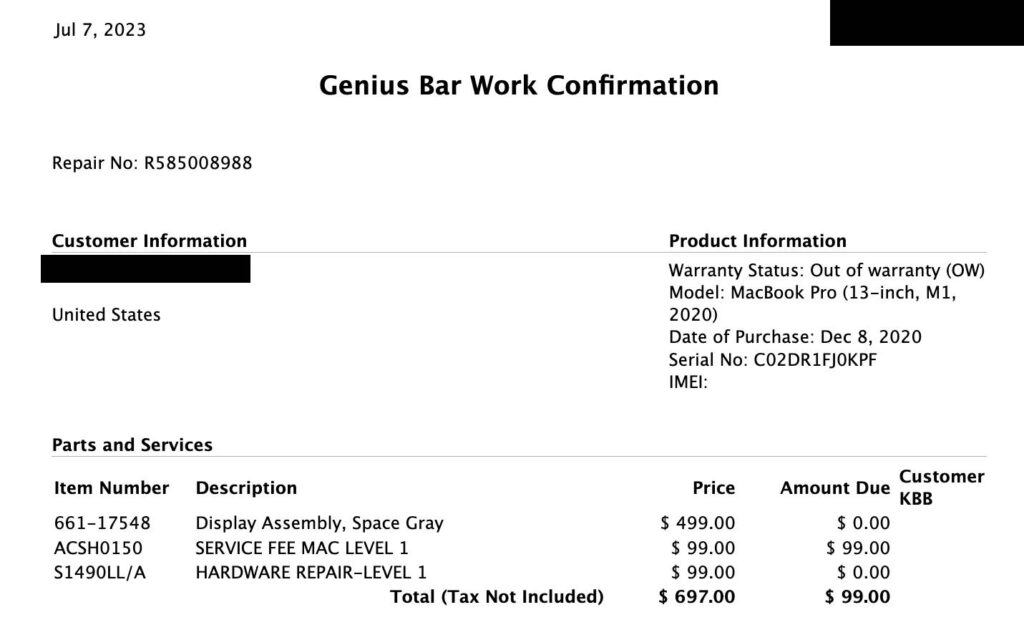
The breakthrough came July 4th weekend, and it was not in the script.
The storm. Thom and Millie’s relationship, the film’s real subject, needed its biggest challenge expressed, and instead of writing it, I generated it: a surreal storm sequence, a Fellini-esque carnival ride at 10,000 feet, the couple’s crisis rendered as weather. The primitive algorithm’s clay-like visuals. This was still the old model, before the change. It produced imagery I was absolutely thrilled by, evocative and molten, and the sequence stands to this day as the film’s most surreal passage. It was just me having fun, expressing through metaphor what the script had expressed through dialogue. But something larger happened that weekend: the film stopped being an adaptation of a live-action script and became a native work of the new medium, a thing that could only exist in the machine. The surreal flourishes that everyone now identifies as the film’s signature were all of this kind: not written in the screenplay, but discovered in the infinite expanse of the tools. The script, I must stress, was serious as can be, a taut live-action thriller. The Monty Python irreverence the finished film is known for was mostly adlibbed at the machine, and it was a dodge as much as a delight: you cannot get a fully serious film out of tools this primitive, so you go strange, you go surreal, you have fun with the limitations rather than losing to them. The silent-era masters figured this out a century before me with far less to go on. In film, any concept can work if you cheat it with enough conviction.
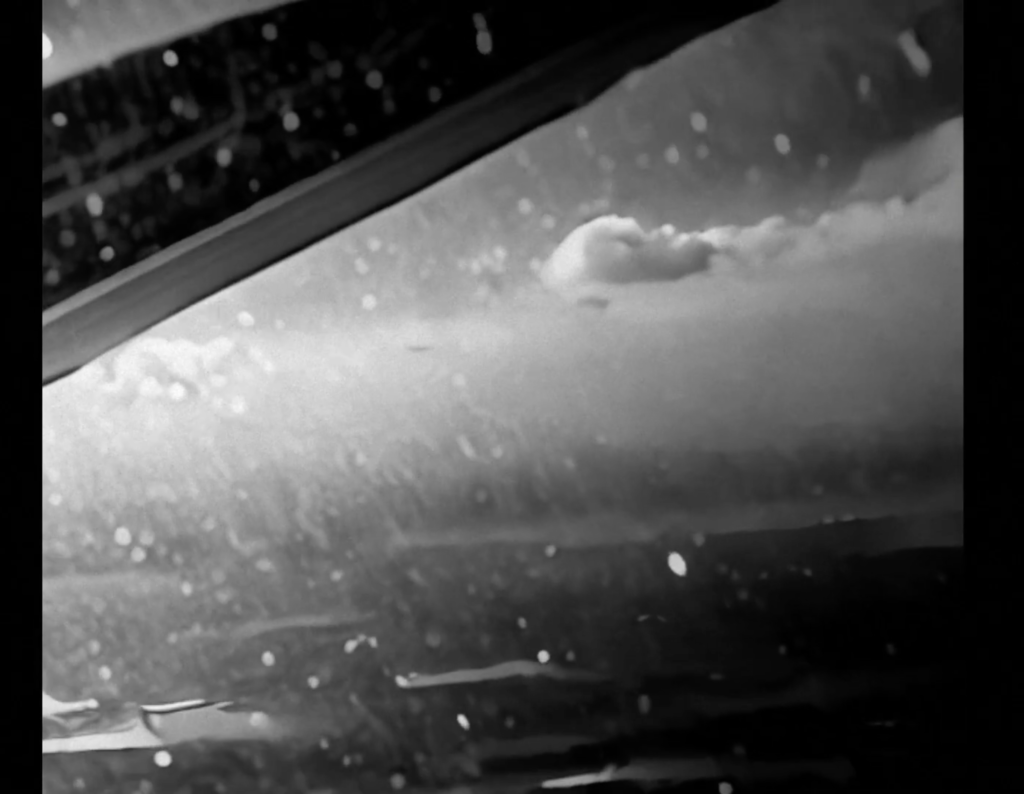
The hardest sequence was the opposite case, the one that could not be dodged. Before the storm come the raw arguments, the film’s dramatic core, the scene built around the line “You killed someone.” No surrealism to hide in, no irreverence to deflect with: performance-only cinema, the chamber piece standing naked, live or die on the acting alone. How could it ever work? Stitching it was a nightmare, the most punishing assembly of the film, and I wasn’t convinced as I powered through it.
On July 19th, I was finished, and five minutes short. The cut stood just under the 60-minute bar, and the bar mattered enormously, because the entire claim rested on the word feature. Definitional bodies disagree: some say 45 minutes, some say 50, some say 60. The Academy itself sets features at anything over 40. But a first gets no benefit of the doubt, ever, and I knew it. The claim had to clear the strictest common threshold, not the loosest, or the debunkers would have their opening. So the safest number was 60, and I took the full final day to earn it: one last montage, built from scratch. The scene was Addison at the skate park, cut in parallel with the news-reporter interview. It seems strange in retrospect that this was not part of the initial cut, because it became the most crucial and suspenseful section of the film, the last five minutes made were among the best. The final runtime was: one hour, one minute, fifty-five seconds. Clear of every definition on earth, with a minute and fifty-five to spare.
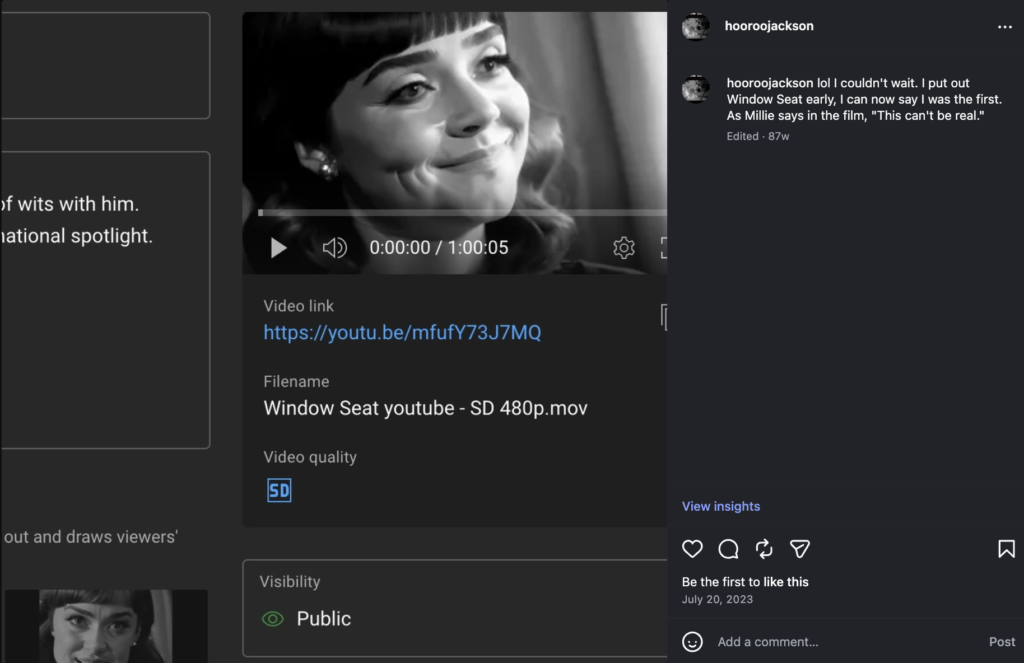
That night, July 19th, I did something impulsive. I posted the film live, briefly, because I was too excited not to, and wrote on Instagram: “I couldn’t wait. The first AI feature film is up.” Then I took it down and held for the real date. The result, unplanned, is that the milestone is double-stamped: a verifiable July 19 completion timestamp sitting behind the July 21 canonical release.

VII. July 21, 2023
That summer, the two most-discussed films on the planet, Christopher Nolan’s Oppenheimer and Greta Gerwig’s Barbie, were opening against each other on the same day, July 21, and the collision had already been memed into a cultural event with its own name. Barbenheimer would go on to open to roughly a quarter-billion dollars domestically in its first weekend, on marketing and production budgets running into the hundreds of millions per film. It was the loudest single weekend theatrical cinema had produced in years, the establishment at maximum wattage.
No independent film in the entire world could compete with that weekend. This was my moment to claim July 21st as my own, not belonging to any Hollywood film, no matter how much money they made. The two of them were the spectacular late summit of a hundred-year-old mode of production. Mine was the arrival of everything that would come after.
And there was a second context that July, one I did not engineer and could not have: Hollywood was on strike over the very technology I was releasing with. The Writers Guild had walked out on May 2, 2023, with AI-written material among its core issues. On July 14, seven days before my release, SAG-AFTRA joined them, the first simultaneous writers-and-actors shutdown since 1960, with digital replicas and AI scanning of performers at the white-hot center of the actors’ case. The American film industry had turned itself off, mid-year, substantially over the question of what machines would be allowed to do to moviemaking. Seven days into that shutdown, one person with no cast, no crew, and $100 released a feature film in which every performance was a machine. The timing made Window Seat less a film release than a thesis statement arriving in the middle of a war.. The hostility the film met was not random internet cruelty aimed at a stranger. It was the sound of history responding in real time.
The release mechanics, for the record. On July 21 the film went up officially on YouTube and on Gumroad, and I purchased advertising for the movie, securing, by any standard, a full public commercial release: available worldwide, promoted, for sale.
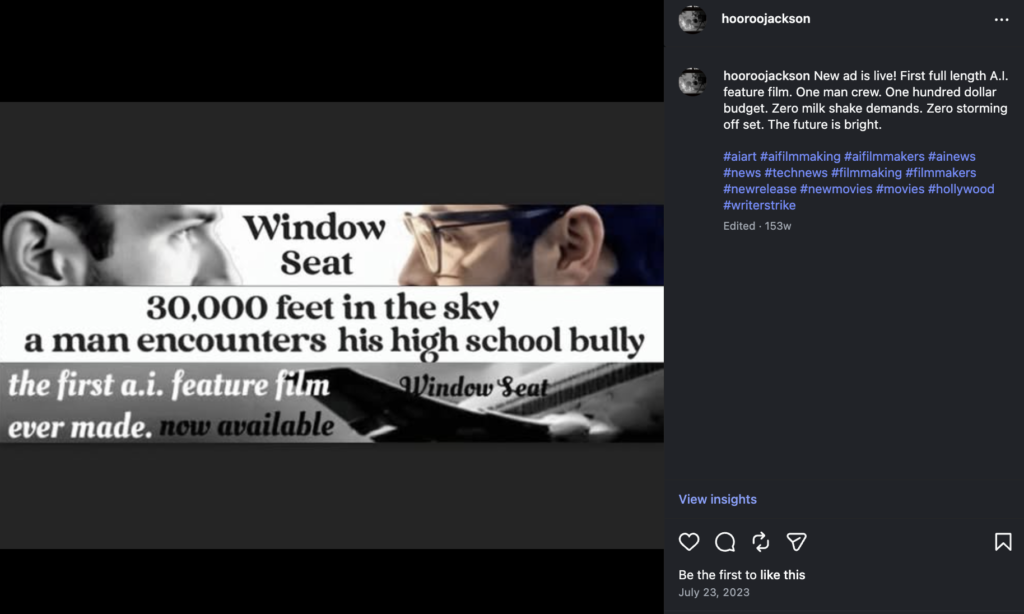
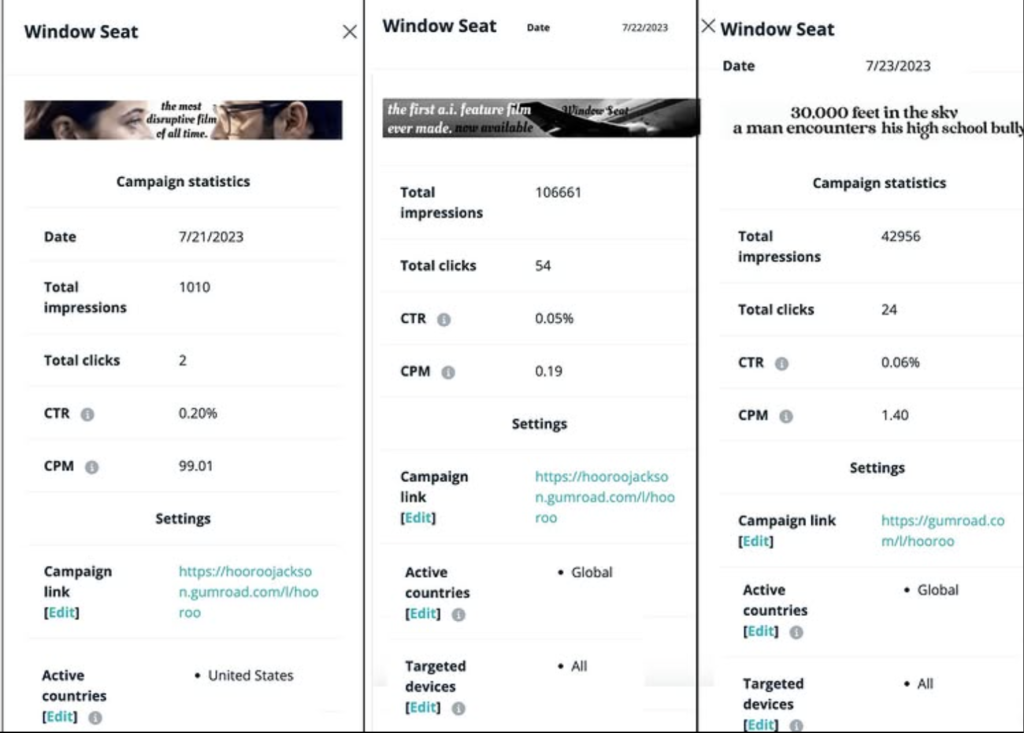
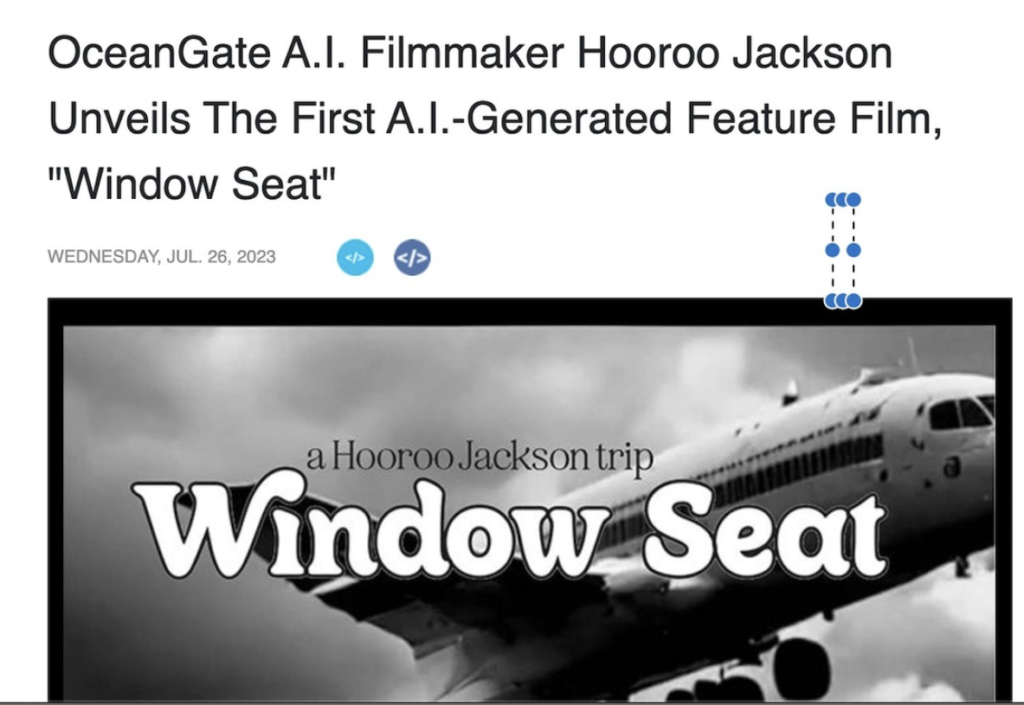
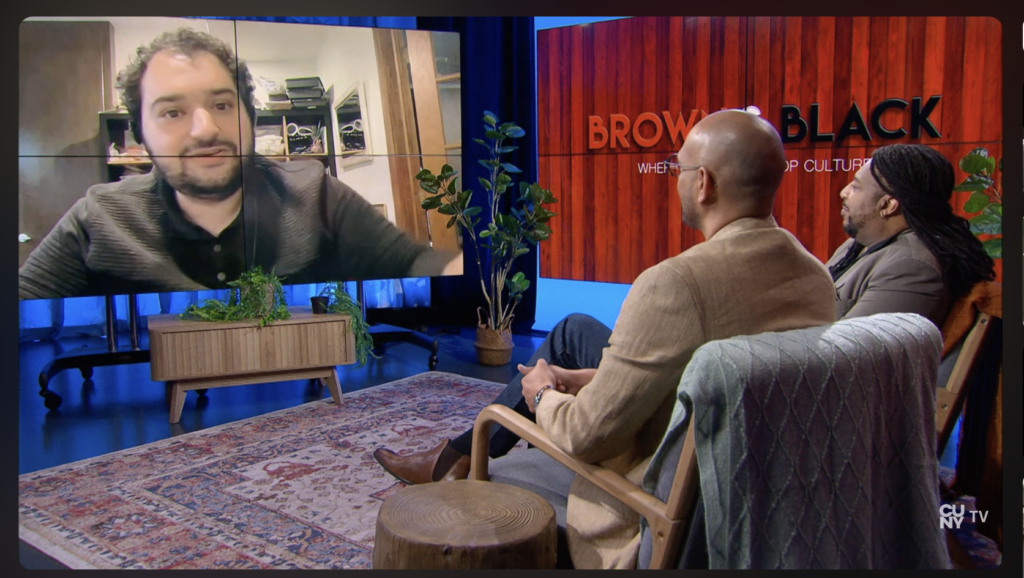
Accompanying the film, I did a small piece of writing in the description, one that was personal to me as a director making his second film, and why he chose AI in this specific moment in time, more a film business diatribe than anything as I felt it was important to mark the moment politically, stamping what I went through on this endless quest to direct my second film. I wrote a press release, the first of my life, and I labored over it absurdly: writing, rewriting, running AI drafts, rewriting again. Every press release I have issued since has been done in a single pass; Window Seat‘s took days, because I understood the symbolic scale. I led the release with the OceanGate short, my most-viewed and most-respected work at the time, as the credential establishing that the person making this claim had a track record in the new medium, however brief. In retrospect, I should have left it out. The release generated three interview requests. One materialized: the Brown & Black podcast’s video division brought me on for a television interview, which aired August 15, 2023, the first broadcast interview ever given about a released AI feature film. Their invitation to return for the podcast proper never actually happened, an early lesson in the half-life of media enthusiasm.
The trailer threw up a small firestorm of its own. It was banned from Reddit immediately upon posting, the first of what would become a long institutional tradition, and the response everywhere else was a churn of sarcasm, hate, anxiety about the future, and, threaded through it unmistakably, begrudging respect. It stands as one of my best trailers ever. It is also close to my last: within a couple of years I stopped cutting formal trailers altogether, having grown to despise the ritual of audiences adjudicating an entire film from ninety seconds with no intention of ever going further.
Then there were the credits, four decisions inside two minutes of screen time, each of which reads differently now than it did then.
First: because no standard existed for any of this, I credited the tools by name in the closing credits, in good faith, the way one credits a lab or a lens. (What became of that good faith belongs to the next section.) Second: the credits list no crew, because there was none, there was only one name, mine, while on screen the film’s pilot celebrates the movie, a machine performer applauding the first machine film, which struck me then and strikes me now as the correct final image. Third: the film ends with a brief, mild sound effect, a siren. I added it because I knew, with total certainty, that the world was about to change, and I wanted the first AI feature film to end on the sound a civilization makes when something is incoming. And fourth, the reversal: the initial cut closed with the words Viva la cinema; this was a celebration, a love letter, cinema greeting a new birth. But when the hate started pouring in, I immediately went in and cut the line. This was not going to be a viva la cinema kind of film; this was a war cry, and the credits needed to match the burning camera the film opened on. In that moment it was absolutely impossible to talk about AI cinema without talking about the film industry itself, the film knew it before I did, and the credits caught up going into the eventual August 22nd revision of the film, the version which stands public to this day:

VIII. Reception
The film was reviewed professionally. In the summer of 2023, critics with standing at Rotten Tomatoes sat down in front of the first AI feature film and wrote about it as a film: as characters, plot, pacing, tone, craft. Whatever they concluded, the act itself settled the question the debunkers would spend years trying to reopen. You do not review a technology. You review a movie. Three critics, all Tomatometer-credentialed at the time, several of whom would gradually lose that status in the platform purges of subsequent years, which is its own commentary on the fragility of the record, entered Window Seat into the professional register, and the film debuted at 3 for 3: a 100 percent score on Rotten Tomatoes.
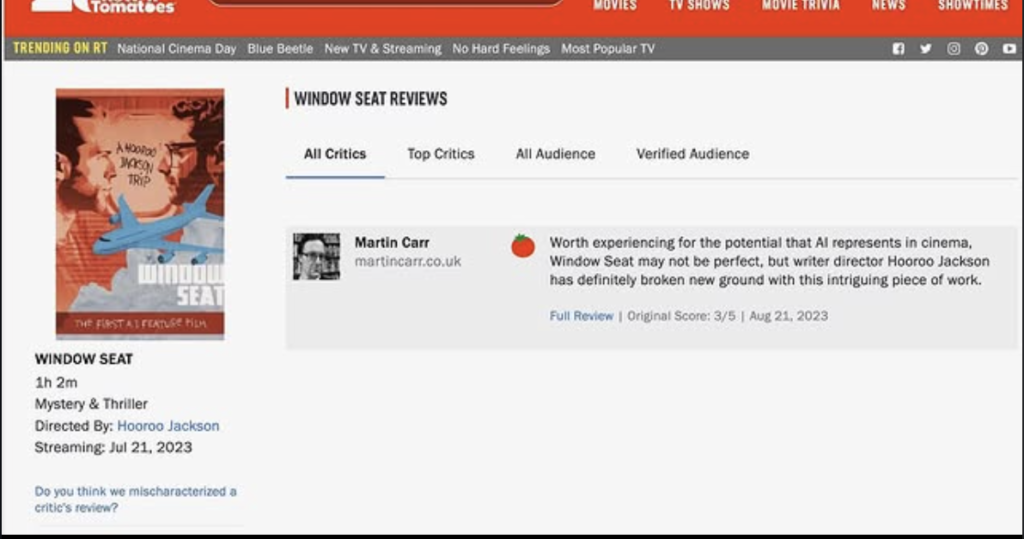
Martin Carr, a RottenTomatoes entertainment journalist, wrote the first. He read Window Seat as a definitive, groundbreaking work and situated it where it belongs: alongside cinema’s rough early landmarks of CGI, those first crude digital objects of the 80s and 90s that were laughed at on release but respected today, because being first and being polished have never once arrived together. He judged the film as history, which I found was right.
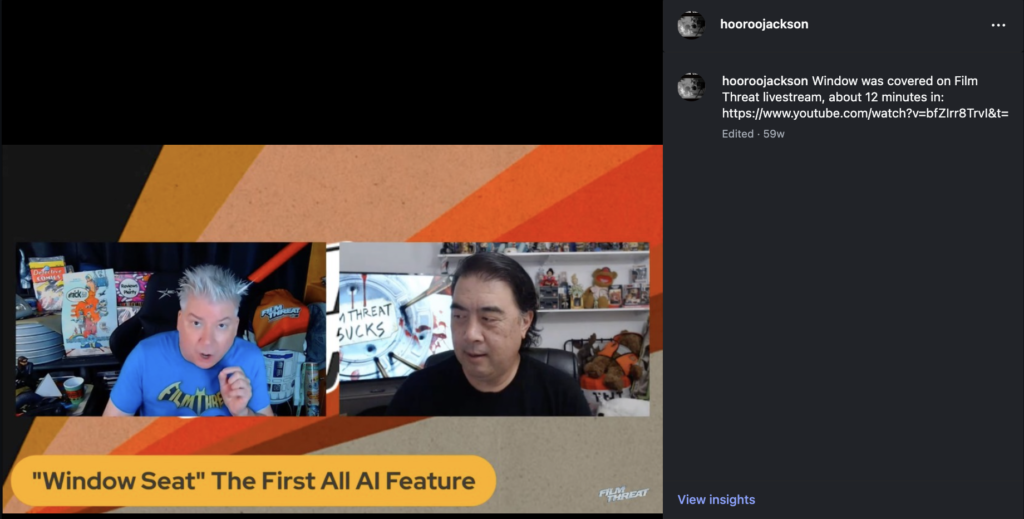
Film Threat delivered the most double-edged review, and the most candor. The reviewer opened by admitting he wasn’t exactly sure whether the voice acting was human, which stood as the film’s greatest victory. In 2023, this was an extraordinary concession and spoke to my considerable efforts in directing machine performances. He then catalogued the visual chaos with a fan’s delight: Millie’s face changing between scenes, airplane rows seating four passengers in one shot and twelve in the next, the parade of mutating nuns, an office party drifting into what he likened to a Chuck E. Cheese, the plane missing its tail, every on-screen text rendering as gibberish. He compared the construction, no shot held longer than a few seconds, to Robert Rodriguez’s El Mariachi. And his verdict was the era in one breath: not a good movie but see it anyway, right now, because the astonishing thing is that it exists, and the tools that made it are sitting on your desk too. A rave and a pan in the same paragraph. Alan was a lot harder on my subsequent films, he broke my heart on both A Very Long Carriage Ride and My Boyfriend is a Superhero!? but I also appreciate the throughline of a professional critic tracking all my work from film-to-film; there were even moments I worked just a little harder on them, thinking, what will Alan think?
Ronak Kotecha, a reporter for the BBC and the Times of India gave the film three stars out of five and split it cleanly down its seam: as an experiment, a groundbreaking attempt at filmmaking; as a plot-driven narrative, uneven at best. He also planted a flag, identifying Window Seat as a serio-comic thriller drama and noting that almost nothing else occupies that shelf. This was the first genre classification ever applied to an AI film, filed by a working critic in September 2023.
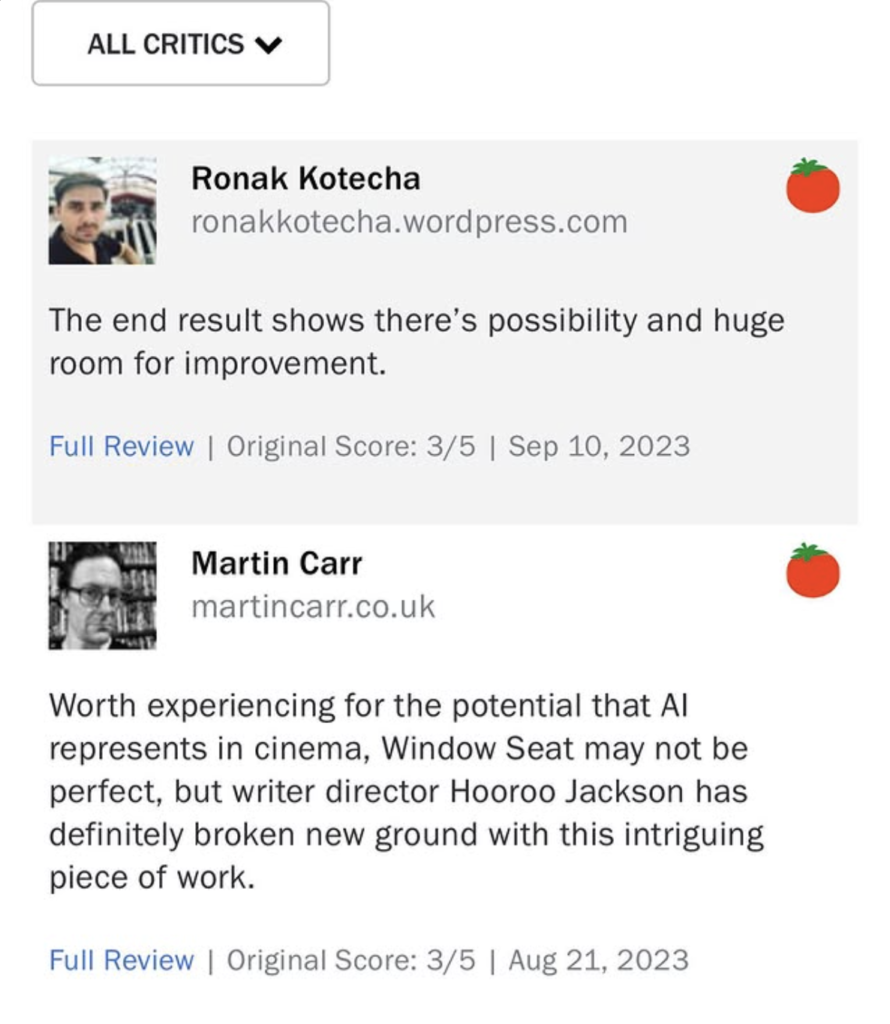
All three reviews respond to Thom, to Millie, to Raiden, to pacing and tone and cuts, to a film in the most classic sense, not a technology. The important thing about Window Seat was that it was professionally legible. That was the entire wager of the production. The same group of critics tracked my work through the entire genesis run. Though the early critics never quite understood the new prospective of one person cinema, analogous to classical writers talking about jazz, they tended to judge the corpus as Hollywood productions, to be fair, it is a new standard difficult to understand from within, even in practice. From my point of view it helps to approach my films from a performance standpoint, and how the machine repertory company is approached from film to film; but a director cannot frame how their films are received, the communication of a work has to be on its own direct terms.
Still, one viewer mattered more than all of them. My father, the man who had told me across all those production phone calls that even if I made this movie, no one would care, watched Window Seat several times. Poured over it. Treated it like the real thing. And I understood why. In 2023, a new film from me still arrived to him as a film by the director of Aimy in a Cage — not as something his son made on a laptop. The debut’s credibility was still attached, and I took to it like a phoenix. So he met the machine film with a cineaste’s seriousness. It never happened again. Notoriously, he fell asleep during the premiere of My Boyfriend is a Superhero!? He would frequently denigrate the entire animated films in front of me, without it entering his mind that I dedicated my life to the form. My mother too mocked that I was watching cartoons when I was studying classic Betty Boop. Later, father never bothered watching Strings at all, a film I believe to be my greatest work in cinema, crossing the live action threshold with the vibrant performance ensemble of sisters, and the breakthrough machine performance Nellie Beaufort; waiting for his reaction left me in an anxious state for weeks. When finally pressed, he responded he watched some of it before moving onto other subjects. At the time, I had assumed the attention he gave Window Seat would last, before releases incomparably more advanced than Window Seat, the miraculous ones, he couldn’t be bothered. I learned the first-time magic gets one showing, even at home, even from your father.
The institutions were another story. Did they care at all this was the first of its kind in history? The answer was a resounding no. The traditional front behaved exactly as predicted. I submitted the film to several film festivals, and the rejections were unanimous. Portland, who had given Aimy in a Cage such an enormous reception, would not return my emails. You would think if one film would warrant it, it would be this one. Where there is precedent today, there was none then. I cannot stress this enough. AI cinema was not understood, conceived of, even a thing besides a ghostly aberration. The new grammar was received as an affront. And there it was on their desk. Window Seat. But festival gatekeeping, I already knew from eight years on the circuit, marks on polish, on the director’s social stock, and on projected appeal to the broadest possible viewer. They genuinely had no idea what was in front of them or even the language to understand or contextualize it.
But the second front drew blood, because I had mistaken it for home ground. I sent Window Seat‘s trailer to roughly twenty-five AI filmmaking companies, influencers, and directors, the entire visible infrastructure of the space I had just planted a flag for. Every single figure in the AI space itself turned their nose up at Window Seat and ignored it outright. The first AI feature film in history could not get an acknowledgment from the AI film world. The reason took me a while to see and has never stopped being true: that institutional layer was never interested in independent filmmakers, it was, exactly as the traditional institutions, positioning itself as the next generation of gatekeepers. The gatekeepers emerged simultaneously as the tools. So you would hear about partnerships popping up on the weekly between these companies and established Hollywood names, which often amounted to nothing real, vs the genesis run itself, ineligible for their attention, perhaps even viewed with active disdain. Once again, Hollywood was all that mattered. The ideation was never the revolution, that was incidental. I stated plainly, independent filmmakers gave them the ick. And I have found no better diagnosis since. So the film stood in a crossfire with no rear: hostility from traditional cinema’s infrastructure, apathy from its supposed successors. Even my allies were far from allies.

IX. Epilogue: The Record
The real war arrived a year later, with DreadClub: Vampire’s Verdict, the first AI animated feature film: a mass campaign led by professional film critics and around-the-clock harassment. Within twenty-four hours of the campaign igniting, the film database Letterboxd deleted Window Seat and my entire AI filmography from the site. When I messaged them, Moderators demanded that my films played in film festivals. This was easy for DreadClub in particular which played numerous festivals and won several prizes. I provided festival receipts. But the moderator immediately moved the goalposts demanding a non-AI festival. This was a requirement set in a climate where few festivals would consider platforming an AI film, a fact the sequence of demands speaks to on its own. When I pointed out their hypocrisy, one, that numerous AI films are allowed on their database who are not held to this requirement (ongoing to this day), and two, that they moved the goal post, they shifted the focus to my anger on the matter as an excuse to terminate the conversation with the instruction never to raise the matter again and that my films would be banned for the rest of time. I got the last word in, telling them to enjoy their sense of power over others while they have it, as machine intelligence will be decentralizing these platforms in the direction of inclusivity, not gatekeeping exclusion. Within a couple weeks regardless, DreadClub played in several non-AI film festivals, winning me Best Director and Best Animated Film accolades, and securing a major streaming license with Amazon Prime. This, one paper should have lead to a full restoration on every database, but by then, it was personal.
Months after that, in October 2024, came a bald-faced attempt to re-write history: another film, released three months after DreadClub and barely brushed by AI at all, carrying a CGI hybrid workflow with AI components, claimed the press as the “first fully AI animated feature” on the novel theory that polish confers primacy. Fellow pioneers, Tasha Caufield among them, stood up for the actual chronology, and my public statement at the time is the only sentence the episode requires: Is the first airplane in history not the first because more polished ones came out later? The important thing is that arguing for polish creates a never ending stream of the ‘true’ first, even still I conferred my pieces would exist in a row with increasing polish regardless. Many came to my defense, saying plainly, it’s not an AI film if it’s not AI. The full accounting of all of it lives in Artificial Imagination: The Making of “DreadClub”. But I would add, there have been dozens of AI feature films since 2023, including several released this year, in 2026, continuing to call themselves the “first AI feature film” in the press. Journalists never do any research and print the headlines regardless; occasionally the producers are forced to defend the claim, and they always repeat the same thing: the others don’t count, we are the true first because we’re the most polished. This logic has created a chain of endless first AI feature films since 2023 all overlapping with each other, discrediting each other, and stating only theirs count. I have kept a running document of about twenty five first AI feature films in history. In studying the evolution of the space however, I must note my personal disappointment. One Person, One Film, is rarer than I hoped. Many of these films are made with teams. Some are actual budgeted films, between $50,000 to $500,000, making me wonder, why? With these budgets you could direct a traditional feature outright, negating the entire purpose of AI cinema and its proposal in post-scarcity filmmaking. My films always land at about a thousand dollars on the dot; it is very important to me that anyone can make these films on any wage. While the constant first AI feature film headlines have created a constant headache, confusing front-facing machine legibility, emails for corrections going ignored. No truth can shake them.
Because I chose the airplane line more carefully than anyone realized.
The Wright brothers flew at Kitty Hawk on December 17, 1903, and then spent decades having it taken from them. The Smithsonian Institution, the official keeper of American technological memory, displayed Samuel Langley’s failed Aerodrome with a label crediting it as the first machine capable of sustained manned flight. The men who actually flew first watched their nation’s own museum hand the milestone to a better-connected machine that had gone into the Potomac twice. Orville Wright’s response was to ship the original 1903 Flyer out of the country entirely to a London museum. The Smithsonian did not fully capitulate until 1942. Until 1948 when the Flyer came home, forty-five years after the flight, and after both the flight’s doubters and Wilbur himself were dead. In that case, the flight lasted twelve seconds while the paperwork took half a century. History does not belong to whoever did the thing. History belongs to whoever documented the thing. The Wrights had the second advantage only barely, and it very nearly wasn’t enough.
I have never had it at all. So I build the archive in public. This essay stands in a lineage of exactly that practice. It is why the legend has receipts, why no revisionist has ever been able to pry the milestone loose. Artificial Imagination functioned this way for DreadClub, at book length, dialogues and all, the Making of for the others followed. But until now, Window Seat, the one every subsequent claim stands on, was the last of my milestones without its own document. The numbers are hereby fixed, with the artifacts attached where marked: written late 2022; produced in the summer of 2023 for $100; roughly 4,000 clips over a machine-performed radio play; completed and timestamped July 19; released July 21, 2023, into the loudest weekend and the angriest month in modern film history; one hour, one minute, fifty-five seconds; one person.
On the night I finished the film, some part of me already knew this document would exist. I had a thought, in the back of my mind, that the anniversary of Window Seat might mean something some day. I am writing this for the third of those anniversaries. The siren I placed at the end of the film was announcing change. Every July 21 that passes, the industry that struck against this technology uses more of it, the institutions that banned the film cover the medium it founded, and the mall I used to walk through carrying my secret is full of people who live inside that secret now and call it ordinary.
The record is the film’s black box, recovered from the flight and published. This is it. Signed, dated, and defended in advance.
Hooroo Jackson
July 21, 2026 — the third anniversary
