Generative Animation (Volume 4 of the New Machine Cinema)
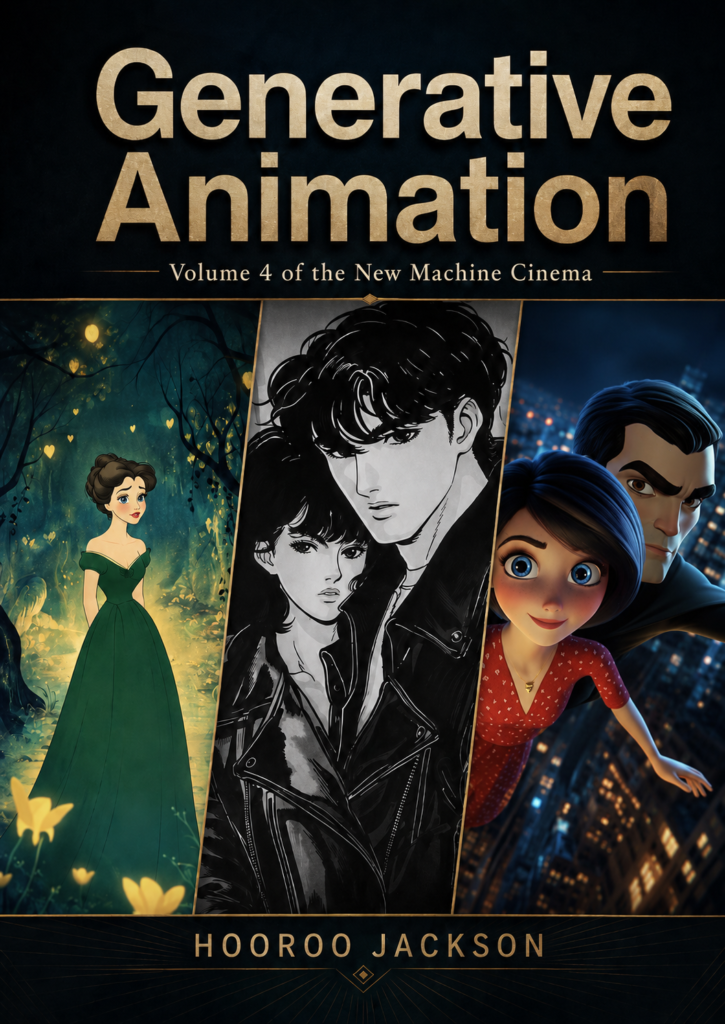 Generative Animation (Volume 4 of The New Machine Cinema)
Hooroo Jackson has directed more AI animated feature films than any filmmaker alive. With DreadClub: Vampire’s Verdict (2024), A Very Long Carriage Ride (2025), and My Boyfriend is a Superhero!? (2025), he produced the first synthetic anime feature, the first AI stop-motion animated feature, the first AI classical animated feature, and the first solo AI 3D CGI animated feature—spanning every major register of animation from a single generative pipeline, at a fraction of the cost of a single traditional production.
Generative Animation is the theoretical architecture behind those films. Where The New Machine Cinema established the foundations of AI film theory, Post-Scarcity Cinema mapped the horizons of a cinema unchained, and Pirate Cinema declared war on institutional gatekeeping, this fourth volume turns to the oldest moving-image artform and argues that AI is not outside animation history—it is the next dominant branch within it, the fulfillment of a tendency the medium has carried since Winsor McCay drew ten thousand frames by hand to make a dinosaur move.
Across eight essays, Jackson dismantles the labor mythology that has governed animation for a century and replaces it with a new ontology built on post-render genesis, directorial curation, and the parametric film:
- The Preparatory Century Is Over
- Post-Render Genesis
- Animation After Labor
- Stop Motion Without Objects
- Style as Variable
- One Film, Three Ways: AI and CG Animation
- The Synthetic Anime
- Three Proofs in Generative Animation
In “The Preparatory Century Is Over,” Jackson traces animation from McCay through Disney, Hanna-Barbera, anime, and Pixar to demonstrate that the medium has always been streamlining itself—shedding labor at every stage while preserving imaginative freedom. AI is not the disruption of that continuity. It is its logical conclusion. “Post-Render Genesis” provides the ontological framework: a new definition of animation capacious enough to survive contact with the entire history of the medium, and a taxonomy that places generative animation alongside drawn, object, and synthetic animation as a fourth major branch. “Animation After Labor” confronts what remains of the animator’s craft when the labor floor collapses, arguing that selection, coercion, and stabilization form a new discipline more concentrated in authorship than the industrial model ever allowed.
“Stop Motion Without Objects” documents the production of the stop-motion A Very Long Carriage Ride—the first AI stop-motion feature—and examines what survives when the puppet vanishes: the drama of materiality, the warmth of the handmade, the performance of inhabitation, all without a single physical object. “Style as Variable” presents the dual release of Carriage Ride as a controlled experiment proving that style, once fused to process, has been severed from it—and that the audience, encountering the same film in two bodies, becomes a participant in the realization of cinema itself. “One Film, Three Ways” extends that logic into CG animation’s sacred territory, breaching the one tradition that had been genuinely closed to independents, while introducing the Choose-Your-Protagonist model, the agentic AI editor, and the True Line Cut through the production of My Boyfriend is a Superhero!?
“The Synthetic Anime” returns to where Jackson’s animation practice began—DreadClub: Vampire’s Verdict—and examines what happens when anime detaches from its national and industrial origins. The essay maps anime’s production philosophy as a pressure system built on scarcity, argues that generative synthesis inherits that philosophy at the level of rhythm and image hierarchy, and posits the synthetic anime as one of the first post-national forms of generative animation. “Three Proofs in Generative Animation” closes the volume by reading the three features as a sequential system: from coherence to variability to architecture, a ratchet that locks into place and cannot be reversed. The experimental phase is over. What remains is the practice.
Generative Animation is the first comprehensive theory of AI animation by the filmmaker who built the field. It is a history of the medium rewritten from the frontier, an ontology that settles the question of whether AI animation is animation, and a practitioner’s account of what it means to direct films when the preparatory century is over and the century of the artist has begun.
🎬 The New Machine Cinema
Volume 1: Foundations in AI Film Theory
Volume 2: Post-Scarcity Cinema
Volume 4: Generative Animation
🎬 Archive Editions
The Making of ‘DreadClub: Vampire’s Verdict’: The Production Journals (Abridged)
The Making of ‘A Very Long Carriage Ride’: The Production Journals (Abridged)
Date:
May 7, 2026